


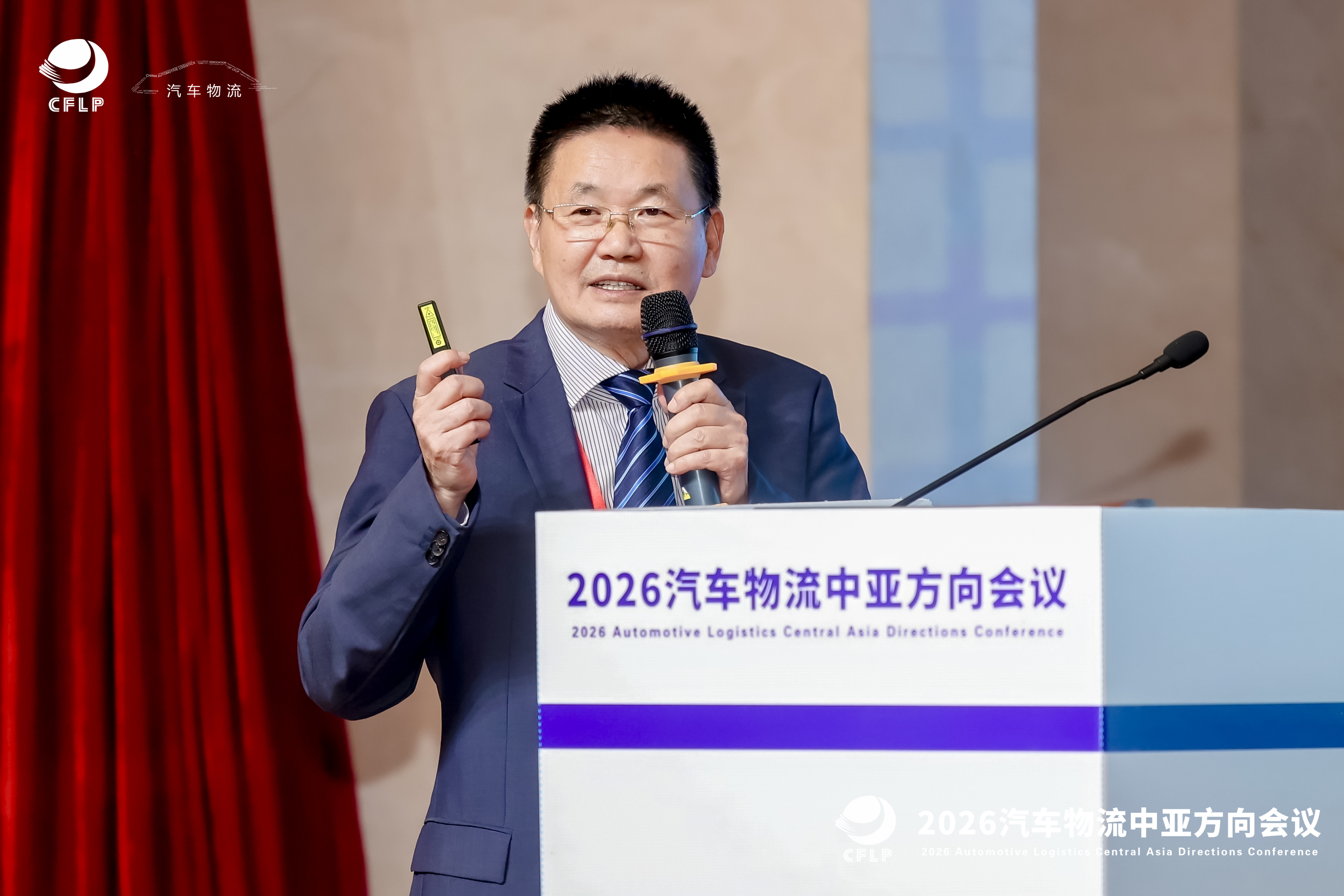
On September 17, 2026, the 2026 Automotive Logistics Central Asia Directions Conference, organized by the China Federation of Logistics & Purchasing (CFLP), was held in Yining, Xinjiang, China. Capt Lin, Chairman of the CAREC Federation of International Logistics and Commerce Associations (CFILCA), was invited to attend and deliver a keynote address titled “Reshaping the Rules: Innovative Practices of International NGOs in Advancing Cross-Regional Road Transport Standardization.”
The conference brought together more than 200 representatives from nearly 100 organizations, including government authorities, industry associations, automotive manufacturers, and international logistics service providers. Representatives from CFLP, the Horgos Municipal Government, customs authorities, and leading automotive manufacturers, including BYD, Changan Automobile, Great Wall Motor, Chery, and Geely, participated in discussions on logistics corridors, cross-border transport, and supply chain coordination supporting China's automotive exports to Central Asia.

As China's automotive industry continues to expand into Central Asian and Russian markets, cross-border automotive logistics is creating new opportunities while placing greater demands on international transport rules, documentation systems, insurance arrangements, and trade finance.

In his keynote address, Capt Lin highlighted three major institutional challenges facing cross-border road transport: fragmented legal frameworks, insufficient transport insurance and liability protection mechanisms, and the limited transferability of traditional land transport documents.
To address these challenges, he introduced three CAREC–ASEAN road transport standards advanced by CFILCA: General Terms and Conditions for International Road Freight Transport, a Standard Road Consignment Note, and Cross-Border Road Freight Trade Terms.
Through a “Unified Consignment Note + Activatable Annexes”approach, these standards aim to improve regulatory coordination and document standardization across different jurisdictions.

Capt Lin also highlighted the institutional opportunities created by the United Nations Convention on Negotiable Cargo Documents (NCD Convention). While traditional land transport documents primarily serve as evidence of transport contracts and receipts for goods, the NCD Convention establishes a new international legal framework for negotiable cargo documents, creating opportunities for the transfer of rights to goods, secured financing, and cross-border trade transactions.
Against this background, CFILCA is advancing research and practical applications of the CAREC-ASEAN Transport Alliance Trade Logistic Document System (CATA TLDS) Designed to align with the NCD Convention, the system seeks to enable land transport documents to perform certain functions traditionally associated with negotiable maritime bills of lading, expanding their potential applications in cross-border logistics, trade finance, and supply chain financing.
Capt Lin proposed exploring cross-regional NCD pilot projects under the Railway Connectivity Standards Scheme (RCSS), jointly promoted by the United Nations Economic and Social Commission for Asia and the Pacific (UN ESCAP) and the China International Sustainable Transport Innovation and Knowledge Center.
He suggested starting with the China–Lao PDR–Thailand–Malaysia international multimodal transport corridor, before gradually expanding to China–Russia, China–Mongolia, and other CAREC transport corridors.
These pilot projects would help assess the applicability of cross-border transport documents across different legal jurisdictions, transport modes, and business scenarios, while advancing document standardization, digitalization, and interoperability.
Capt Lin emphasized that regional connectivity requires not only “hard connectivity” through physical infrastructure, but also “soft connectivity” through harmonized rules, standards, transport documents, insurance mechanisms, and trade-related institutions. Joint participation in developing and implementing these frameworks is essential to overcoming institutional barriers to cross-border transport.

CFILCA's participation in the conference further strengthened exchanges with Chinese automotive manufacturers, logistics service providers, and industry organizations, creating new opportunities to connect regional transport standardization initiatives with the practical needs of the automotive logistics sector.
Looking ahead, CFILCA will continue to leverage its regional membership and international cooperation network to advance research, standards cooperation, and pilot applications in international road transport, multimodal logistics, cross-border transport documentation, and trade facilitation.
Through these efforts, CFILCA aims to promote a transition from infrastructure connectivity toward greater regulatory and institutional coordination, supporting more efficient cross-border logistics and the sustainable development of regional trade and supply chains.