
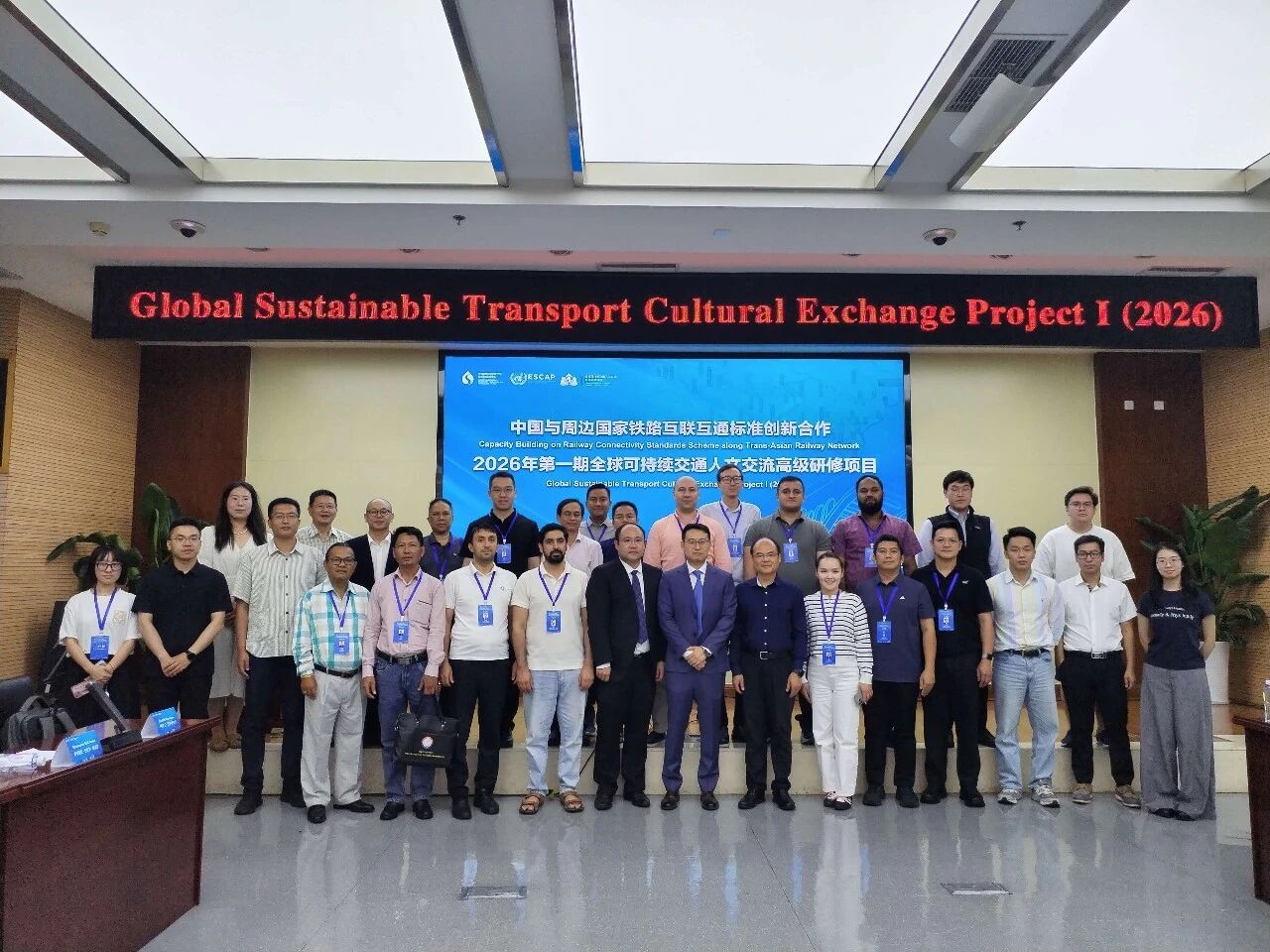
Recently, an international workshop on the joint development of digital standards for Pan-Asian Railway multimodal transport was successfully held at Southwest Jiaotong University. The CAREC Federation of International Logistics and Commerce Associations (CFILCA) participated in the workshop as a Chinese expert organization, joining technical experts from the United Nations Economic and Social Commission for Asia and the Pacific (UN ESCAP), as well as experts from the China International Sustainable Transport Innovation and Knowledge Center, Southwest Jiaotong University, the Kunming Institute for International Logistics in South and Southeast Asia, and other institutions.
The workshop brought together 20 senior transport-sector participants from 13 countries, including Azerbaijan, Bangladesh, Cambodia, Kazakhstan, Lao PDR, Malaysia, Mongolia, Myanmar, Pakistan, Russia, Tajikistan, Thailand and Viet Nam. Participants held in-depth discussions on digitalization of cross-border railway multimodal transport, data standards and regional interoperability.
The workshop focused on the proposal entitled “Cross-Border Multimodal Data Standards and Key Interoperability Technologies.”
The proposal is part of the cooperation promoted by the China International Sustainable Transport Innovation and Knowledge Center and UN ESCAP to advance digital connectivity for Pan-Asian Railway multimodal transport. It aims to establish consistent, trusted and reusable data exchange rules for cross-border multimodal transport scenarios across the Asia-Pacific region, with railways as a backbone.
The initiative seeks to facilitate data interoperability among railways, ports, roads, waterways, logistics hubs, logistics enterprises and relevant government authorities, providing technical support for the transition from “hard connectivity” in infrastructure to “soft connectivity” through rules and standards.
As an international industry organization committed to international logistics rules coordination, standards cooperation and regional logistics development, CFILCA shared its practical experience in international logistics standardization, cross-border transport rules innovation, digitalization of international land transport documentation, and logistics data interoperability.
CFILCA also engaged extensively with UN ESCAP technical experts and representatives from participating countries, contributing professional recommendations on the joint development of digital standards for international railway multimodal transport in the Asia-Pacific region.
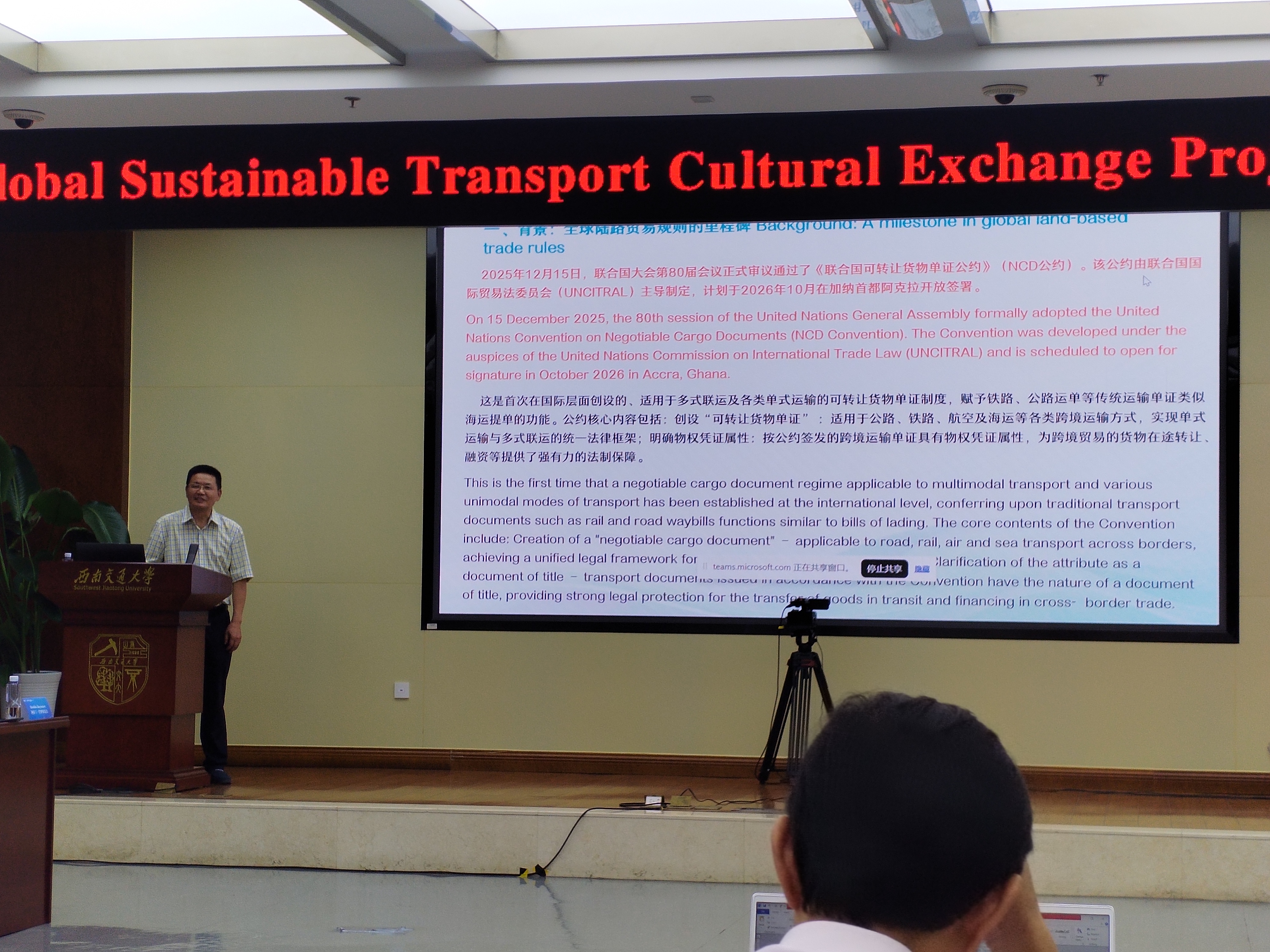
Following extensive discussions, participants proposed establishing a Joint Technical Working Group under the Railway Connectivity Standards Scheme (RCSS) to conduct collaborative research in key areas, including digital standards for Pan-Asian Railway multimodal transport, interoperability and adaptation of freight data across countries, and secure cross-border data sharing.
The workshop also identified the China–Lao PDR–Thailand–Malaysia international multimodal transport corridor as the first pilot corridor. The pilot will explore the alignment and interoperability of data rules among participating countries, promote mutual recognition of relevant standards, and support the development of an integrated land-sea data collaboration network.
These efforts are expected to reduce information exchange and communication costs in cross-border logistics, improve data coordination among different modes of transport, and provide standards-based support for greater logistics efficiency and trade facilitation across the region.
The workshop further strengthened the shared understanding of digital standards cooperation for railway transport in the Asia-Pacific region and laid a solid foundation for further research on international railway multimodal transport digital standards, cross-border data interoperability and pilot project cooperation.
Going forward, CFILCA will continue to leverage its role and professional strengths as an international industry organization, strengthening cooperation with United Nations agencies, international organizations, research institutions, industry associations and enterprises.
CFILCA will actively participate in the development of international digital standards for logistics, promote the coordination of international logistics rules, advance joint standards development and facilitate cross-border transport, contributing its professional expertise to the Belt and Road Initiative and the high-quality development of international logistics across the Asia-Pacific region.

The Railway Connectivity Standards Scheme (RCSS) was formally endorsed on September 12, 2025, during the Ninth Meeting of the Working Group on the Trans-Asian Railway Network under UN ESCAP.
Building on the RCSS framework, the proposed initiative will bring together relevant countries, international organizations, research institutions and industry stakeholders to conduct collaborative research on cross-border multimodal transport data objects, code mapping, status events, secure data exchange and pilot validation.
The initiative aims to develop replicable and scalable regional rules and technical solutions for transport data interoperability, supporting more efficient digital connectivity across the region.
The proposal was introduced during the Global Sustainable Transport Humanistic Exchange Advanced Training Programme, under the theme “Innovative Cooperation on Railway Connectivity Standards between China and Neighboring Countries.”
The programme was jointly organized by the China International Sustainable Transport Innovation and Knowledge Center and the Transport Division of UN ESCAP. It brought together 20 transport-sector participants from Azerbaijan, Bangladesh, Cambodia, Kazakhstan, Lao PDR, Malaysia, Mongolia, Myanmar, Pakistan, Russia, Tajikistan, Thailand and Viet Nam, together with experts from UN ESCAP, the China International Sustainable Transport Innovation and Knowledge Center, universities, research institutions and industry organizations.
Through continued technical cooperation and pilot implementation, the initiative seeks to advance practical solutions for cross-border data interoperability and contribute to stronger digital connectivity, transport efficiency and trade facilitation across the Asia-Pacific region.